


Folks who have served in the military are familiar with this quote from Ben Franklin: “If you fail to plan, you are planning to fail.”
When people think about financial plans, sometimes they’re put off, imagining a process that’s difficult and a document that’s lengthy. But it doesn’t need to be.
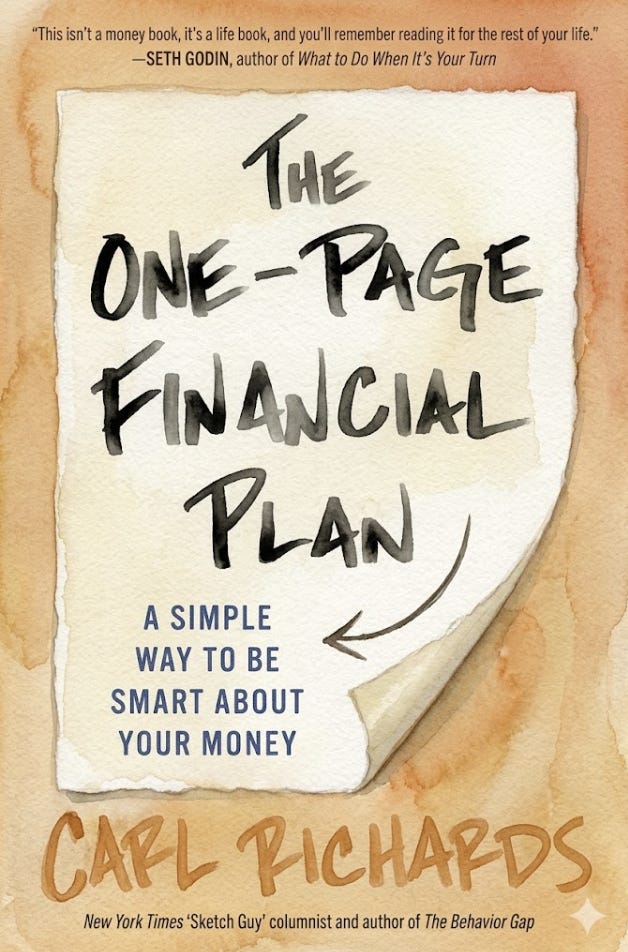
Author Carl Richards, in fact, is an advocate of the simplest possible plan—a concept he described in his book The One-Page Financial Plan. His message: Your plan doesn’t need to be literally one page, but the idea is that it doesn’t need to be 30 or 50 pages either. Ultimately, the heart of a financial plan is really just a simple and clear set of goals accompanied by a plan to start moving in the direction of those goals. You can always refine it further as you go along.
I sometimes describe the ideal plan as one that you could recite while standing on one foot. To be sure, there’s work that needs to go into it. But it should also be simple enough that you can keep it in mind for reference at all times.
What might that look like in practice? Here’s an example of a plan that is both robust and sufficiently simple:
Each year until retirement, we will contribute the maximum to our 401(k)s.
In addition, we’ll put away $10,000 in our taxable brokerage account.
We’ll plan to retire at ages 62 and 65.
By retirement, our mortgage will be paid off, and our annual spending will be $180,000 per year in today’s dollars.
When we’re both age 70, Social Security will cover about half of that total, and our portfolio will cover the remainder.